Work / ● Oracle · Current

Unified Assurance

Network service assurance for telco NOCs. A Redwood modernization of Oracle's service assurance platform, designed for the teams watching the network stay up.

Role
Sole UX Designer
Team
PM, engineering
Timeline
Jun 2025 - present
Platform
Desktop web · Redwood DS
Status
In flight
The case at a glance
6surfaces
One coordinated system across two personas - Admin and NOC engineer
1agent
Network Operations Assistant - correlates events into act-on-able situations
SoleUX owner
Only designer on the product, and owner of the agentic experience
TL;DR

Unified Assurance is Oracle's service assurance platform - the tool telco Network Operations Centers use to watch whether the network is healthy, catch faults before customers notice, and route events to the right engineer. I joined as the sole UX designer on a team that had never worked with UX before. My job was to take a platform built in the engineering-era and move it onto Redwood, while building the UX practice the team needed to maintain it after handoff. The story of UA is less about screens and more about bringing a UX process to a team that didn't have one.

01

The situation

Imagine AT&T's Dallas NOC. A network engineer sees an alert: a regional router in New York is dropping packets at 3:47am local. The alert came from a sensor that pinged the device, found a threshold exceeded, fired an event into the service assurance platform. If the platform is doing its job, that event reaches the engineer with enough context to diagnose, triage, and fix before customers in New York wake up and notice their service degrading.

Unified Assurance is Oracle's platform for that work. It sits downstream of device monitoring and upstream of ticketing - the layer where raw events become triaged signals. For years the platform did the work but the UI lagged. Legacy screens built over time; patterns from different eras stacked next to each other; new engineers onboarding took weeks to learn what each view actually did.

Oracle's decision was to rebuild UA onto the Redwood Design System - part of a broader modernization of Oracle Communications' product surface. I joined as the only UX designer on a team that had never previously worked with a UX function.

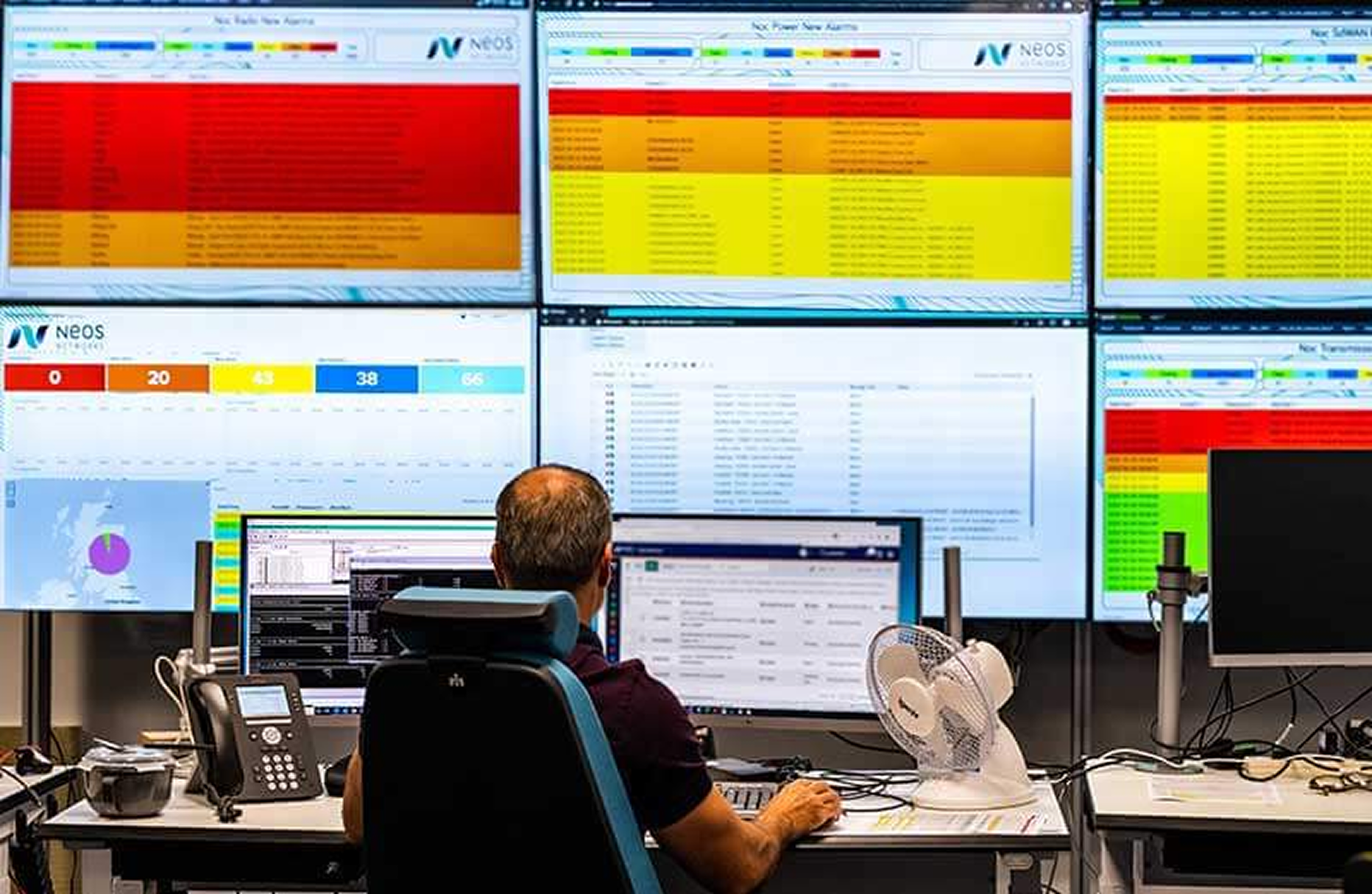
A NOC engineer facing a wall of monitors flooded with red, orange and yellow alarm tables
Fig. 01 · The NOC reality - engineers monitoring a wall of undifferentiated alerts. The "sea of red" that framed the redesign.
The PM did not know what Redwood was, or what UX was, when I joined. The calls I made weren't contested - they were trusted once rationale became visible.
On solo UX in a UX-naive team
02

The decisions that mattered

On UA I am the only UX voice - there is no peer designer in project meetings. My peer review happens externally: in Oracle's quarterly Industry UX All-Hands, where designers across Oracle's industry portfolio review the work, and in internal Communications syncups with adjacent design groups. Inside the project, the decisions below weren't argued against competing UX positions. They were calls I made because the team didn't yet have the context to frame the tradeoffs - and trusted once I made the reasoning visible.

Decision 01
Sequence by customer handover, not NOC volume.

The intuitive order was to tackle the highest-traffic surfaces first - Event Management and the NOC Dashboard, since those are where engineers spend most of their day. I argued for the opposite. I sequenced Admin surfaces first - Installation, Onboarding, Device Discovery - because those are the moments when a customer becomes a user. Get those right and adoption compounds; get those wrong and the most-polished NOC dashboard doesn't matter because users never reach it.

Decision 02
Shape of Data before wireframes.

Before any wireframe on UA, I wrote Shape of Data documents per surface - quantitative definitions of how much data each view would hold, how many events per minute, how dense the dashboard could get before it became noise. Engineering built against numbers rather than sketches. PM could scope with confidence. Every design argument had a reference point.

Decision 03
"Ask Oracle" as primary nav, not AI feature.

The obvious design move for an AI assistant was to bury it as a help icon. I made it primary navigation. "Ask Oracle" sits at the top of every UA surface, and the same pattern propagates across the Unified Operations Suite - Assurance, Fulfillment, Service Design. The rationale: in a product surface this broad, users don't know which screen holds the answer they need. Conversational search wasn't a nice-to-have; it was the navigation model that made the suite coherent.

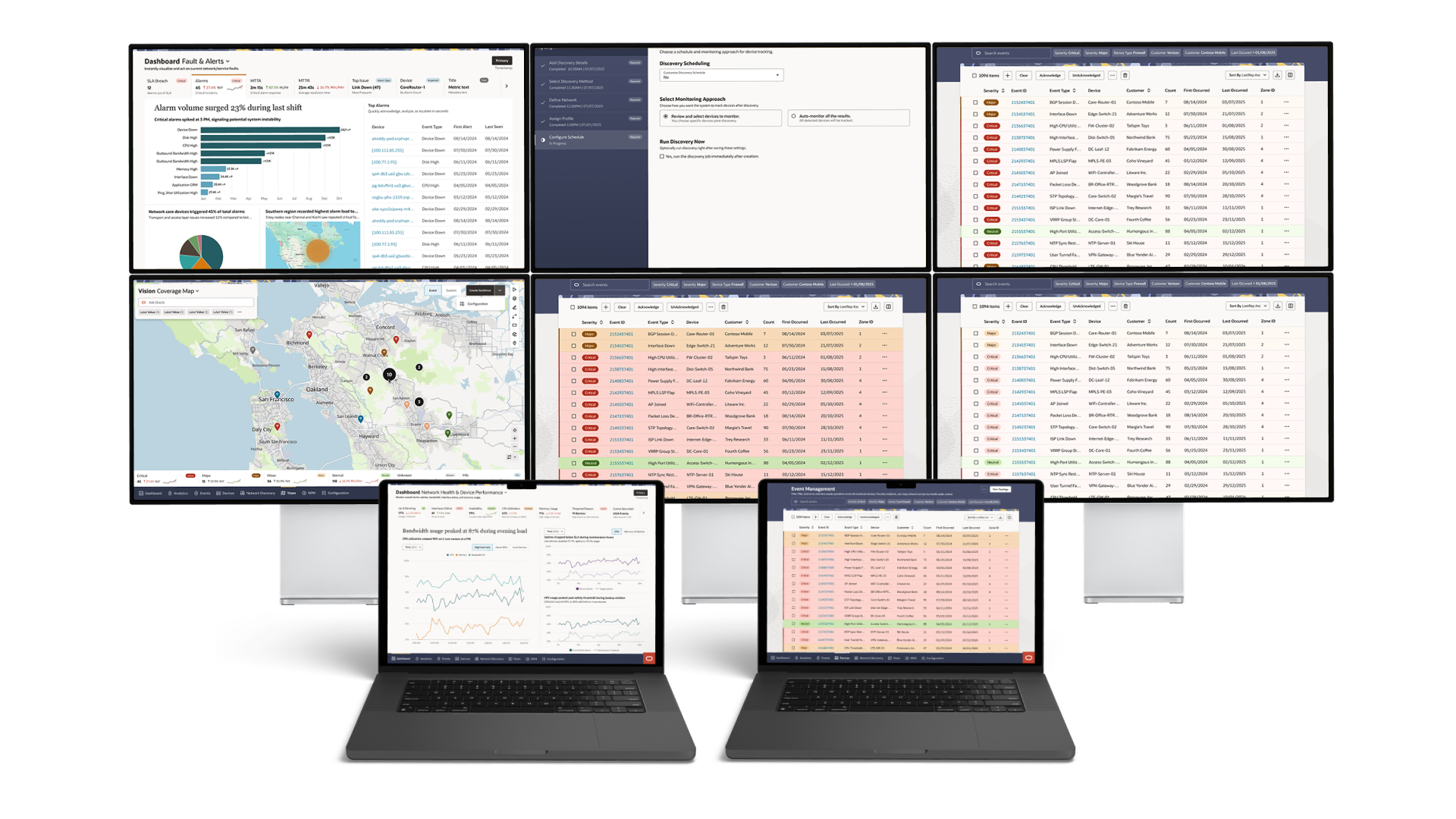
The Redwood-modernized Unified Assurance surfaces - dashboard, event management, device discovery and Vision map
Fig. 02 · The same platform, rebuilt on Redwood - dashboard, event management, device discovery and the Vision coverage map.
03

The six surfaces

UA isn't a single screen - it's a set of surfaces that together form the NOC's day, split across two personas. The Admin sets the system up and keeps it healthy; the NOC engineer lives in monitoring and triage. I designed them as one coordinated system, sequenced so a customer is onboarded before they ever reach the monitoring surfaces. Sitting across all of them is the agentic layer - the Network Operations Assistant - which is where this work is heading next.

Unified Assurance · six surfaces
Admin · onboarding
Installation
In UX
Admin · onboarding
Onboarding
In UX
Admin · ops
Device Management
In dev
Admin · shipped
Device Discovery
Shipped
NOC · monitoring
Vision
In dev
NOC · monitoring
Dashboard
In dev
NOC · triage
Event Management
In dev
Agentic layer · across all surfaces
Network Operations Assistant
Correlates events into situations · assigns by skillset · guides resolution
Fig. 03 · Six surfaces across two personas, with the agentic layer sitting on top of all of them.
04

The agentic layer

A NOC engineer's hardest moment isn't seeing that something is wrong - it's deciding what to do about it, fast, while alerts pile up from every direction. The newest and most current work on UA is an agentic operations experience: a Network Operations Assistant that helps an engineer investigate, prioritise, and resolve a fault situation, with AI doing the correlation and the engineer keeping the judgment. I own the design of this agentic experience end to end.

A situation isn't one device fault. It correlates many events across multiple devices into a single working hypothesis anchored to one device - so instead of reading a hundred alert rows, the engineer reads one story. The design challenge was never "add AI." It was making AI output something an engineer under pressure can actually trust and act on.

I structured each situation around the six questions a NOC engineer asks, in the order they ask them: what's broken (root cause), how bad and who's hit (service impact), how long have I got (SLA impact), what's the evidence (event pattern), is it getting worse (affected metrics), and can I act (readiness). The layout follows how an engineer reads and works a page, so even a beginner can understand the situation and act with confidence.

The agent assigns the right situations to the right engineers by skillset - and an engineer can request a different situation if the assigned one is beyond their depth. When they're ready to act, they can send a communication to the field or apply the recommended resolution directly from the situation, guided by an AI action summary.

The principle I kept returning to: an AI finding has to be accountable. Every card shows its work - the claim, the signal behind it, the evidence it came from, and the action it enables - so a recommendation reads as "here's why," not "trust me." I also cut things that failed that test: an evidence balance bar that implied a weighting the data couldn't support, and any language suggesting the system had acted when it hadn't. That honesty is the difference between an engineer acting on the AI and quietly ignoring it.

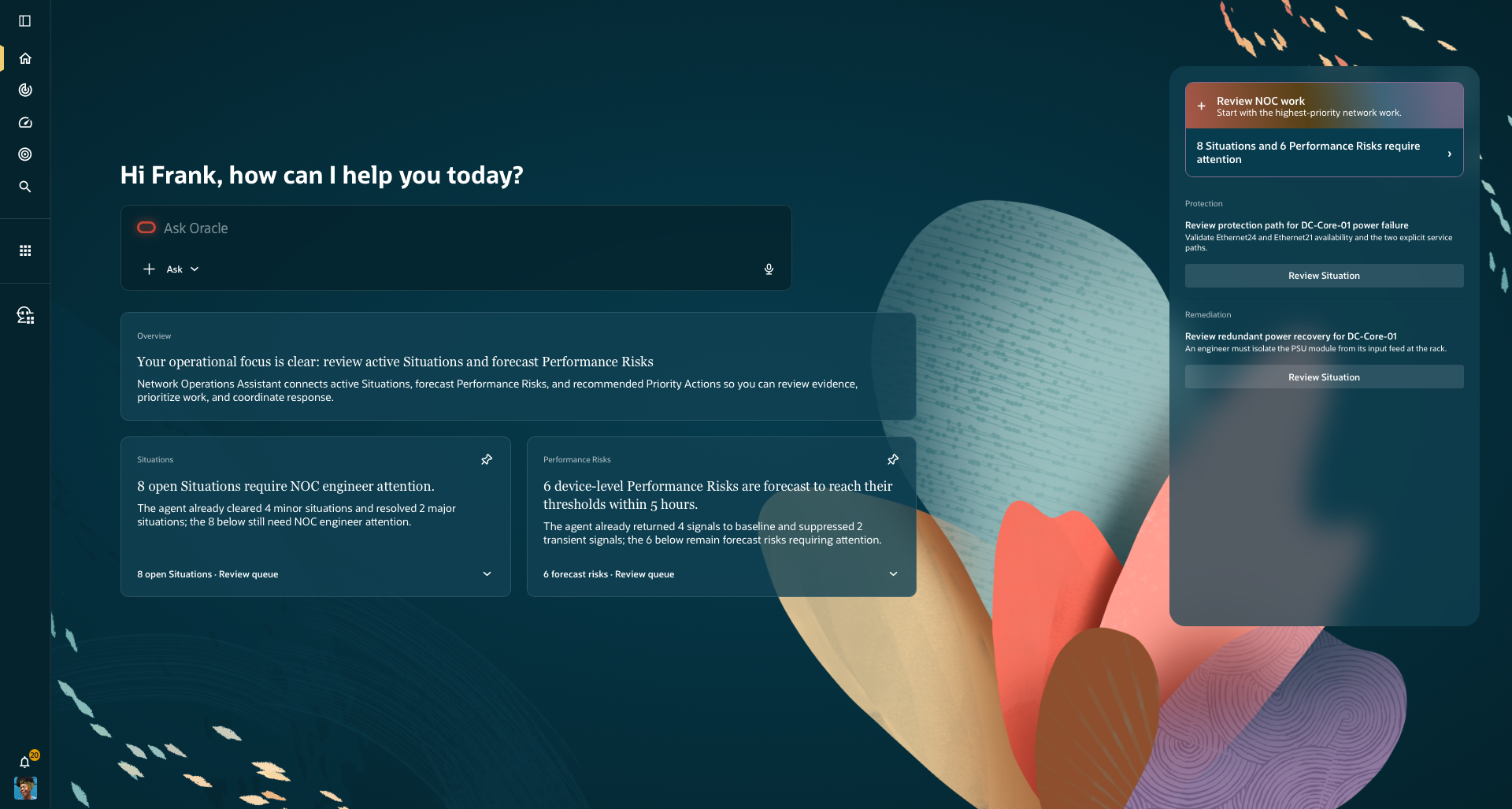
The Network Operations Assistant home - Ask Oracle with open situations and forecast performance risks
Fig. 04 · The Network Operations Assistant - the engineer's briefing home, surfacing open situations and forecast risks with recommended priority actions.
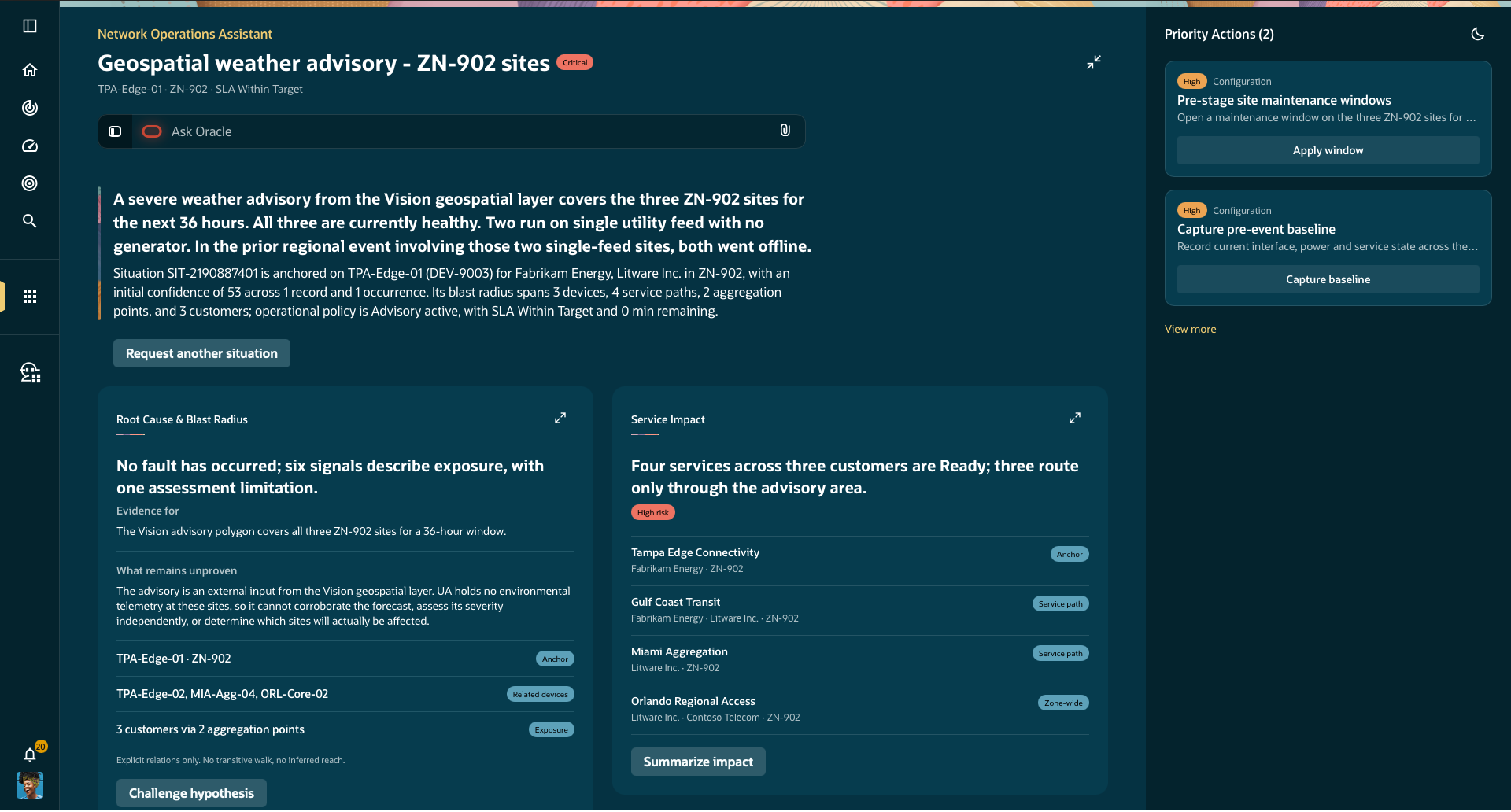
A single situation opened - root cause and blast radius, service impact, and priority actions, each card showing its evidence
Fig. 05 · One situation open - each card answers a question the engineer asks and shows its evidence, so the AI recommendation reads as "here's why."
05

Validation

UA has no dedicated design peer inside the team. Validation happens across three venues, all external to the project itself.

Oracle's quarterly Industry UX All-Hands is where I present the work to designers across Oracle's industry portfolio. That venue forces me to defend Shape of Data numbers, IA principles, and the "Ask Oracle" suite-nav decision to designers who weren't in the rationale. Each round sharpens the argument.

Internal Communication syncups with Oracle Communications' broader design groups are the second loop - same register, tighter cadence. The third loop is the Quarterly Infrastructure Design all-hands, where UA's surfaces get reviewed alongside other Oracle infrastructure products for consistency.

An AI finding has to be accountable. If it can't show why, an operator under pressure will quietly ignore it - and then the intelligence was never worth building.
On designing the agentic layer
06

Status

Shipped
Device Discovery - the first UA surface released to customers with the new Redwood design.
In dev
Vision, Dashboard, Event Management, Device Management - UX-complete, in engineering development.
In UX
Installation and Onboarding - currently in active UX design, sequenced as customer-handover surfaces.
07

What I'd change

Start with sales, not PM.
When I joined, I anchored my first conversations around the PM's view of the product. In retrospect, sales had the deeper customer context - which telcos were asking for what, where the real friction lived for existing UA customers, which features actually drove renewal versus which ones got demo'd but never adopted. Starting there would have sharpened the sequencing decision earlier.
Build a "What Redwood modernization is and isn't" doc in week one.
On a team new to UX and new to Redwood, I spent the first month re-explaining scope in meetings. A one-page shared document early would have saved weeks of repeated framing. Next project, that's the first artifact I produce.
Next case study →